

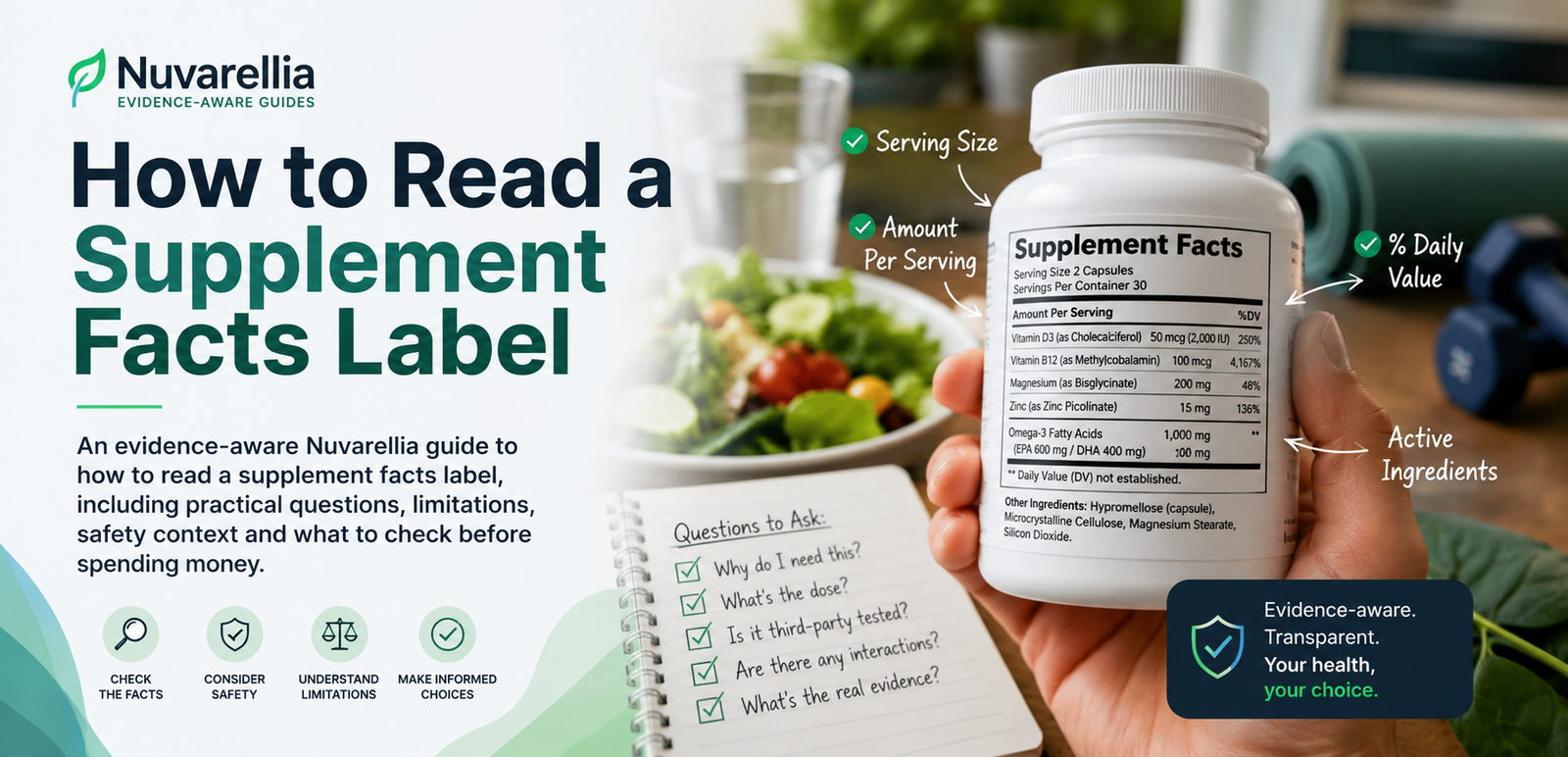
An evidence-aware Nuvarellia guide to how to read a supplement facts label, including practical questions, limitations, safety context and what to check before spending money.
The short version
Nutrition and supplements are full of simple-sounding claims, but useful decisions depend on dose, context, total diet, individual needs and the quality of evidence. How to Read a Supplement Facts Label is best approached as a decision problem: define the goal, identify what evidence actually addresses that goal, check safety and limitations, then compare cost and alternatives.
What matters most
- Start with the underlying need rather than the product category.
- Prefer specific, measurable information over vague words such as “detox,” “boost,” “miracle,” or “clinically inspired.”
- Separate evidence about an ingredient or technology from evidence about the exact finished product.
- Consider dose, duration, population studied and meaningful outcomes—not just whether a study was “positive.”
- For persistent symptoms, severe symptoms, pregnancy, medication use or a diagnosed condition, involve an appropriate licensed professional.
How to evaluate the evidence
A useful hierarchy begins with authoritative public-health guidance and high-quality systematic reviews, then moves to well-designed randomized trials when they answer the same question. A biological mechanism can be interesting without proving a meaningful benefit in everyday use. Small studies, surrogate outcomes and studies funded by interested parties are not automatically invalid, but they deserve more context.
When a seller says a product is “clinically proven,” ask what was actually tested. Was it the exact product? How many people participated? Was there a control group? How long did the study last? Were the outcomes important to consumers? Were harms and dropouts reported?
Label and product checklist
Before buying, check the complete ingredient or specification list, serving size, directions, warnings, manufacturer identity, total cost, subscription terms, shipping, return policy and whether the seller makes claims that go beyond the evidence. For dietary supplements, FDA distinguishes health claims, nutrient-content claims and structure/function claims; supplements are not approved like drugs before marketing, and disease-treatment claims are a major red flag.
Benefits, uncertainty and trade-offs
The right question is rarely “does it work?” in isolation. A better question is: for whom, for what outcome, compared with what, by how much, for how long, and with what downsides? Benefits can be modest yet worthwhile when cost and risk are low. Conversely, a dramatic claim backed only by weak evidence should not become more persuasive because the packaging looks scientific.
Safety questions to ask
Consider allergies, interactions, age, pregnancy or breastfeeding, kidney or liver disease, planned surgery and other relevant conditions. “Natural” does not mean risk-free. If a product could delay needed diagnosis or treatment, the downside is larger than the purchase price.
How Nuvarellia would compare options
We compare products on transparency, evidence relevance, realistic usefulness, price, recurring cost, return terms, customer-service accessibility and claim quality. We do not award a positive review because an affiliate commission is available. If a commercial relationship exists, it should be disclosed near the relevant link.
Practical takeaway
For how to read a supplement facts label, begin with the simplest evidence-based option that addresses the actual goal. Add a product only when it offers a clear advantage in convenience, adherence, comfort or a reasonably supported outcome. Keep expectations proportional to the evidence.
Sources and further reading
- NIH Office of Dietary Supplements — Fact Sheets: https://ods.od.nih.gov/factsheets/list-all/
- FDA — Dietary Supplements Q&A: https://www.fda.gov/food/information-consumers-using-dietary-supplements/questions-and-answers-dietary-supplements
- FDA — Label Claims: https://www.fda.gov/food/nutrition-food-labeling-and-critical-foods/label-claims-conventional-foods-and-dietary-supplements
Editorial note
This article is educational consumer information, not medical advice. Nuvarellia uses authoritative references as a starting point and distinguishes independent evidence from seller claims. The article should be updated when guidance or material evidence changes.