

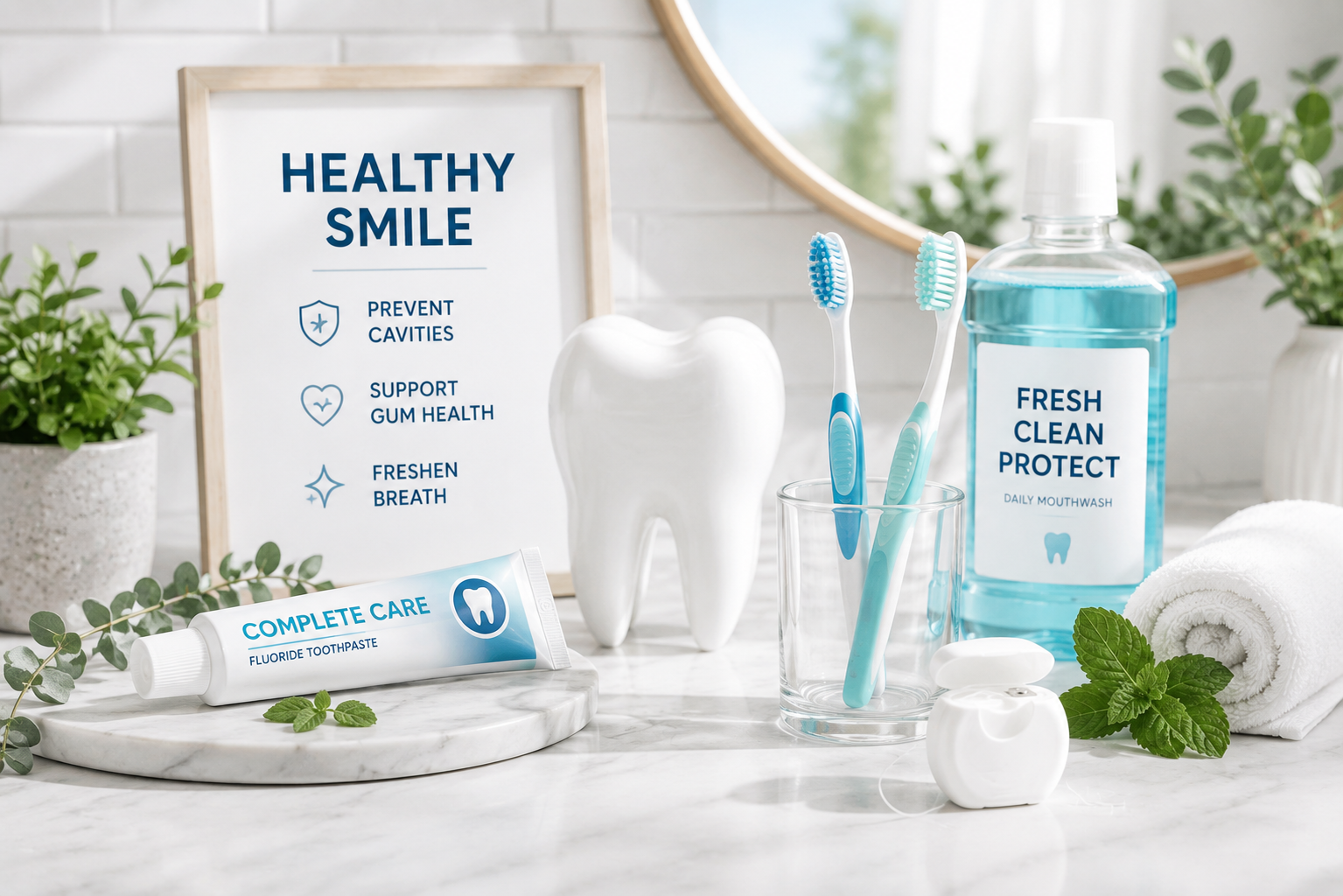
Fluoride toothpaste remains the most evidence-backed everyday defense against cavities for adults. Learn how fluoride works, what 1,000–1,500 ppm means, when prescription-strength toothpaste is appropriate, how to choose a sensitivity formula, and which common fluoride claims do—and do not—match the evidence.
A toothpaste aisle can make cavity prevention look more complicated than it is. One box emphasizes whitening, another enamel repair, another sensitivity relief, and a fluoride-free option may promise a more natural approach. Yet for most adults in the United States, the central decision is straightforward: choose a toothpaste that contains fluoride, use it consistently, and select additional features based on your specific oral-health needs.
The concise answer
For most adults, a fluoride toothpaste containing roughly 1,000 to 1,500 parts per million (ppm) fluoride is a sound everyday choice. Brush with it twice daily, clean between your teeth, limit frequent exposure to sugary or acidic foods and drinks, and keep regular dental visits. Fluoride does not make teeth immune to decay, but it helps shift the balance toward repair after acid attacks and makes enamel less vulnerable to future mineral loss. The American Dental Association (ADA) and Centers for Disease Control and Prevention (CDC) both support regular brushing with fluoride toothpaste for cavity prevention. ([cdc.gov](https://www.cdc.gov/oral-health/prevention/about-fluoride.html?utm_source=openai))
If you have repeated cavities, exposed root surfaces, dry mouth, orthodontic appliances, or other high-risk conditions, a dentist may recommend additional fluoride or a prescription toothpaste containing 5,000 ppm fluoride. That is a risk-based treatment decision—not a reason for every adult to use the highest concentration available. ([ada.org](https://www.ada.org/resources/ada-library/oral-health-topics/fluoride-topical-and-systemic-supplements?utm_source=openai))
Five key takeaways
1. Fluoride toothpaste has the strongest evidence for routine cavity prevention. Systematic-review evidence supports a meaningful benefit compared with non-fluoride toothpaste, although the amount of adult-specific evidence is smaller than the evidence in children and adolescents. ([cochrane.org](https://www.cochrane.org/evidence/CD007868_fluoride-toothpastes-different-strengths-preventing-tooth-decay?utm_source=openai))
2. For everyday adult use, concentration matters, but consistency matters too. Most U.S. over-the-counter fluoride toothpastes contain approximately 1,000 to 1,500 ppm fluoride. ([ada.org](https://www.ada.org/resources/ada-library/oral-health-topics/fluoride-topical-and-systemic-supplements?utm_source=openai))
3. Fluoride works mainly through ongoing topical contact with teeth and plaque. It helps inhibit mineral loss, promote remineralization of early lesions, and reduce some acid-producing activity in dental plaque. ([cdc.gov](https://www.cdc.gov/oral-health/prevention/about-fluoride.html?utm_source=openai))
4. Sensitivity toothpaste can be combined with cavity protection. Look for a fluoride toothpaste that also contains a desensitizing ingredient such as stannous fluoride, potassium-based ingredients, or arginine when sensitivity is a priority. ([pubmed.ncbi.nlm.nih.gov](https://pubmed.ncbi.nlm.nih.gov/36753794/?utm_source=openai))
5. A fluoride-free toothpaste is not automatically safer or equally protective. Some non-fluoride ingredients, including hydroxyapatite, have promising studies, but the overall evidence base and professional consensus remain stronger for fluoride toothpaste. ([cochrane.org](https://www.cochrane.org/evidence/CD007868_fluoride-toothpastes-different-strengths-preventing-tooth-decay?utm_source=openai))
How cavities begin—and where fluoride fits
Cavities develop through repeated cycles at the tooth–plaque–saliva interface. Bacteria in plaque metabolize fermentable carbohydrates and produce acids. Those acids can pull minerals out of enamel and, later, dentin. Saliva helps buffer the acids and supplies calcium and phosphate that can support repair. When mineral loss repeatedly exceeds repair, an early lesion can progress toward a cavity.
Fluoride does not simply form a permanently invulnerable coating over the tooth. Its most important effects occur in the fluid surrounding teeth, including saliva and dental plaque. After brushing, fluoride becomes available at the tooth surface and within plaque. It can help slow acid-driven mineral loss and accelerate the redeposition of mineral into early, noncavitated areas. Fluoride can also interfere with some bacterial acid production, particularly when the plaque environment becomes acidic. ([cdc.gov](https://www.cdc.gov/oral-health/prevention/about-fluoride.html?utm_source=openai))
A useful way to think about fluoride is as a repair-and-protection aid. It cannot rebuild a large hole, replace lost tooth structure, or remove hardened tartar. But when enamel is weakened rather than structurally collapsed, fluoride can improve the conditions for remineralization and make subsequent acid challenges less destructive. Once decay has formed a true cavity, professional treatment may be needed.
The topical nature of this effect is one reason regular exposure matters. The ADA notes that brushing with fluoride toothpaste substantially raises fluoride levels in saliva for a limited period after brushing. This supports the logic of repeated daily use rather than occasional “extra-strength” use. ([ada.org](https://www.ada.org/resources/ada-library/oral-health-topics/fluoride-topical-and-systemic-supplements?utm_source=openai))
What does 1,000, 1,100, 1,450, or 1,500 ppm mean?
“ppm” means parts per million. On a toothpaste label, it describes the concentration of fluoride available from the product’s active fluoride compound. It is not the same as the percentage of the entire toothpaste tube that is fluoride.
In the United States, over-the-counter fluoride toothpastes generally fall in the range of about 1,000 to 1,500 ppm. Common active compounds include sodium fluoride, sodium monofluorophosphate, and stannous fluoride. These compounds differ chemically, but all are used to deliver fluoride for anticavity protection when formulated appropriately. ([ada.org](https://www.ada.org/resources/ada-library/oral-health-topics/fluoride-topical-and-systemic-supplements?utm_source=openai))
The evidence does not support treating every small numerical difference as clinically decisive. A 1,450-ppm toothpaste is not automatically dramatically better than a 1,100-ppm toothpaste for every adult. However, systematic-review evidence supports fluoride toothpaste over non-fluoride toothpaste, and evidence from permanent teeth suggests that higher concentrations can provide additional caries protection in some populations, particularly when baseline cavity risk is higher. The certainty and directness of evidence vary by age, concentration, brushing behavior, and outcome measured. ([cochrane.org](https://www.cochrane.org/evidence/CD007868_fluoride-toothpastes-different-strengths-preventing-tooth-decay?utm_source=openai))
For a practical decision:
- Typical adult with no special risk factors: A reputable 1,000–1,500 ppm fluoride toothpaste is reasonable.
- Adult who prefers a sensitivity product: Choose a fluoride-containing formula with a supported desensitizing active ingredient.
- Adult with recurrent decay or high-risk conditions: Ask a dentist whether a prescription-strength product or additional fluoride treatment is appropriate.
- Adult considering fluoride-free toothpaste: Understand that this gives up the most established anticavity active ingredient unless a dental professional has advised otherwise.
Over-the-counter versus prescription-strength toothpaste
Prescription-strength fluoride toothpaste in the U.S. commonly contains 5,000 ppm fluoride. It is intended for selected patients at elevated risk—not as a universal upgrade for people who simply want a stronger clean. The ADA guideline on nonrestorative treatment of carious lesions identifies 5,000-ppm fluoride toothpaste or gel as an option clinicians may prioritize for certain root-surface caries situations. ([ada.org](https://www.ada.org/-/media/project/ada-organization/ada/ada-org/files/resources/research/chairside_guide_nonrestorative_treatments_for_carious_lesions_on_permanent_teeth.pdf?hash=E38FAD20965E24E543BD815980E07413&rev=c691e42e41274c27b41a7c67b9eb988d&utm_source=openai))
A dentist may consider higher-strength fluoride when someone has a pattern of new cavities, exposed root surfaces, reduced saliva, extensive restorations, certain medications or medical conditions that cause dry mouth, or difficulty controlling plaque. The decision depends on the person’s examination and risk profile.
Prescription-strength does not mean “better for everyone.” Higher fluoride exposure can be useful when the expected benefit outweighs the risks and inconvenience, but it should be used according to professional instructions. Do not borrow someone else’s prescription toothpaste or assume that using more of a high-fluoride product will compensate for inconsistent brushing.
Choosing a toothpaste when your teeth are sensitive
Tooth sensitivity usually feels like a brief, sharp response to cold, air, touch, or sweet foods. It can occur when dentin becomes exposed through gum recession, enamel wear, erosion, abrasion, or other changes. Sensitivity is a symptom, not a diagnosis. A single painful tooth, lingering pain after hot or cold exposure, pain on biting, swelling, or spontaneous toothache may indicate decay, a cracked tooth, pulpal inflammation, or another problem that toothpaste cannot fix.
For ordinary dentin hypersensitivity, a fluoride toothpaste with one of several desensitizing ingredients may be reasonable. Recent systematic reviews of randomized trials in adults found evidence supporting self-applied dentifrices containing stannous formulations, potassium with or without stannous fluoride, or arginine for reducing sensitivity pain. However, the studies used different formulations, stimuli, follow-up periods, and outcome measures, so the results should not be interpreted as proof that one brand is best for everyone. ([pubmed.ncbi.nlm.nih.gov](https://pubmed.ncbi.nlm.nih.gov/36753794/?utm_source=openai))
A practical comparison:
| Need | What to look for | What to expect |
|---|---|---|
| Everyday cavity prevention | Fluoride, usually 1,000–1,500 ppm | Reduced risk over time, not total protection |
| Sensitivity plus cavity protection | Fluoride plus stannous, potassium-based, or arginine desensitizing ingredients | Improvement may require consistent use; response varies |
| High cavity risk | Dentist-directed 5,000-ppm fluoride or additional professional fluoride | More intensive prevention based on individual risk |
| Whitening | Fluoride plus stain-removal ingredients | Removal of some surface stains, not bleaching of every discoloration |
| Fluoride-free preference | Non-fluoride active such as hydroxyapatite | Some encouraging evidence, but less established consensus for cavity prevention |
Stannous fluoride may offer more than fluoride alone in some products because stannous compounds can also have effects relevant to sensitivity, plaque, gingivitis, or erosion. But finished products differ in formulation, flavor, abrasivity, and stability. Ingredient lists are useful, yet product-level claims still need to be interpreted cautiously. ([ada.org](https://www.ada.org/resources/ada-library/oral-health-topics/toothpastes?utm_source=openai))
If sensitivity does not improve, becomes localized, or is accompanied by other symptoms, schedule a dental evaluation rather than continually switching toothpastes.
How to evaluate labels and marketing claims
Start with the active-ingredient panel
For cavity prevention, confirm that the product contains a fluoride active ingredient. In the U.S., the relevant ingredients commonly include sodium fluoride, sodium monofluorophosphate, or stannous fluoride. The concentration is usually listed in ppm or as a percentage on the packaging.
Consider the ADA Seal of Acceptance
The ADA Seal is not the only possible marker of a useful toothpaste, but it is a meaningful shortcut. For accepted fluoride toothpastes, manufacturers submit evidence and product information for review against ADA requirements for safety and efficacy. The ADA also evaluates fluoride availability and other product characteristics. The FDA establishes requirements for eligible over-the-counter anticaries products through its monograph, but the FDA does not individually test every toothpaste to verify compliance. ([ada.org](https://www.ada.org/resources/ada-library/oral-health-topics/toothpastes?utm_source=openai))
The Seal is best understood as evidence that a specific product met defined criteria for a specific claim. It is not a declaration that the toothpaste is ideal for every person, nor does it mean every non-Seal product is ineffective.
Separate cosmetic claims from therapeutic claims
“Whitening” commonly refers to removal of surface stains through abrasives or other ingredients. It does not necessarily mean the product changes the intrinsic color of teeth. “Enamel repair” may refer to support for remineralization of early mineral loss, not reconstruction of a chipped or cavitated tooth. “Natural” describes a marketing category, not a demonstrated level of cavity protection.
Be especially cautious with claims that a toothpaste can detoxify the mouth, eliminate the need for dental care, reverse every cavity, or provide protection equivalent to fluoride without comparable clinical evidence.
What the evidence supports—and what remains uncertain
Stronger consensus
The broadest agreement is that fluoride toothpaste prevents cavities better than non-fluoride toothpaste when used for routine brushing. The Cochrane review of fluoride toothpastes included 96 studies and found evidence supporting fluoride toothpaste over non-fluoride toothpaste. It also found evidence of a concentration-response pattern in children and adolescents, while adult-specific evidence was more limited. ([cochrane.org](https://www.cochrane.org/evidence/CD007868_fluoride-toothpastes-different-strengths-preventing-tooth-decay?utm_source=openai))
CDC guidance supports brushing at least twice daily with fluoride toothpaste and identifies fluoride as beneficial for both children and adults. The ADA similarly recommends fluoride toothpaste for most people and identifies common U.S. over-the-counter concentrations as approximately 1,000–1,500 ppm. ([cdc.gov](https://www.cdc.gov/oral-health/prevention/about-fluoride.html?utm_source=openai))
Areas with more uncertainty
The evidence is less definitive when comparing every concentration, active ingredient, and branded formulation directly. A laboratory study, a short-term sensitivity trial, and a multi-year caries-prevention trial answer different questions. A product that increases mineral deposition in an enamel specimen is not automatically proven to prevent cavities in ordinary adult users.
Hydroxyapatite is a good example. An 18-month randomized clinical trial in adults compared a fluoride-free hydroxyapatite toothpaste with a 1,450-ppm fluoride toothpaste and reported similar outcomes under that study’s prespecified noninferiority framework. That is an informative study, but it is still one trial, with a defined population, duration, formulation, and study design. It does not erase the much larger historical evidence base supporting fluoride toothpaste. ([pubmed.ncbi.nlm.nih.gov](https://pubmed.ncbi.nlm.nih.gov/37533523/?utm_source=openai))
Similarly, sensitivity research supports several active ingredients, but comparative rankings can be unstable because trials differ in baseline sensitivity, testing methods, placebo composition, brushing instructions, and manufacturer involvement. The 2023 network meta-analysis included 32 studies and 4,638 participants but also called for more standardized methods. ([pubmed.ncbi.nlm.nih.gov](https://pubmed.ncbi.nlm.nih.gov/36753794/?utm_source=openai))
Safety, common concerns, and red flags
For adults, fluoride toothpaste is generally considered safe and effective when used as directed. The main everyday precaution is to spit out excess toothpaste rather than intentionally swallowing it. Fluoride products are regulated as drugs under the FDA’s anticaries framework, and accepted products must meet applicable safety and efficacy requirements. ([cdc.gov](https://www.cdc.gov/oral-health/prevention/about-fluoride.html?utm_source=openai))
Dental fluorosis is primarily a concern when young children ingest excessive fluoride while permanent teeth are developing. That is why caregivers should supervise children, use age-appropriate amounts, and follow professional guidance. Adult use of fluoride toothpaste does not generally create the same fluorosis concern because adult teeth have already developed.
Seek dental care promptly for:
- Facial or gum swelling
- Fever with dental pain
- A broken or visibly cracked tooth
- Pain that lingers after hot or cold exposure
- Pain when biting
- A dark spot, hole, or food trap that persists
- Sensitivity limited to one tooth or steadily worsening
- Dry mouth with frequent new cavities
These signs may reflect disease requiring examination, restoration, periodontal treatment, medication review, or another intervention. Toothpaste alone is not a substitute for diagnosis.
A simple decision framework
Use this four-step process when choosing:
1. Protect against cavities first. Unless your dentist has given a different plan, prioritize fluoride.
2. Match the concentration to your risk. An everyday 1,000–1,500 ppm product is appropriate for many adults; ask about prescription-strength fluoride if your risk is high.
3. Add one targeted feature. Choose sensitivity control, gingivitis support, stain removal, or another feature according to your actual need—not because the package lists the most benefits.
4. Check whether the product is tolerable. A toothpaste that tastes acceptable and does not irritate your mouth is more likely to be used consistently. If a product causes burning, peeling, rash around the mouth, or persistent irritation, stop using it and ask a dental professional about alternatives.
Reader FAQs
Is fluoride toothpaste necessary if I drink fluoridated tap water?
For most people, yes. Fluoridated water and fluoride toothpaste provide related but distinct opportunities for fluoride exposure, and CDC and ADA guidance continue to recommend brushing with fluoride toothpaste. Water fluoridation does not replace brushing, plaque removal, or cleaning between teeth. ([cdc.gov](https://www.cdc.gov/oral-health/prevention/about-fluoride.html?utm_source=openai))
Is 1,500 ppm fluoride toothpaste too strong for adults?
Not generally. Approximately 1,000–1,500 ppm is within the common over-the-counter range in the United States. The appropriate product depends on your oral-health risk, ability to use it as directed, and any advice from your dentist. A higher concentration is not automatically necessary simply because it is available. ([ada.org](https://www.ada.org/resources/ada-library/oral-health-topics/fluoride-topical-and-systemic-supplements?utm_source=openai))
Can fluoride toothpaste reverse a cavity?
It can support remineralization of some early, noncavitated areas of mineral loss, but it cannot fill a structural hole or repair a broken tooth. A dentist must determine whether a lesion is active, arrested, reversible, or in need of restoration or another treatment.
Is fluoride-free toothpaste a reasonable choice?
It may be a personal preference, but it is not the evidence-equivalent default for cavity prevention. Some fluoride-free formulations, including hydroxyapatite products, have clinical research behind them, yet fluoride toothpaste has the longer and broader evidence base and remains the standard recommendation from major U.S. dental and public-health organizations. If you are at elevated risk for decay, discuss the choice with your dentist before switching. ([cochrane.org](https://www.cochrane.org/evidence/CD007868_fluoride-toothpastes-different-strengths-preventing-tooth-decay?utm_source=openai))
The bottom line
For most U.S. adults, the best toothpaste is not the one with the longest list of promises. It is a fluoride toothpaste in the usual over-the-counter range that you can use consistently and comfortably. Choose a sensitivity ingredient if you need one, consider the ADA Seal as a helpful third-party signal, and ask a dentist about 5,000-ppm prescription toothpaste if you have a high risk of decay or root-surface lesions.
Fluoride is not a miracle coating and it does not cancel out frequent sugar exposure, dry mouth, plaque accumulation, or missed dental care. But the evidence is clear enough to support a practical conclusion: routine fluoride toothpaste use is one of the simplest, most established ways adults can reduce their risk of cavities.
Where this guide gets its evidence
We prioritize primary research, government health agencies, clinical guidance and other high-authority sources. Seller pages are used only for product-specific facts, not as proof of effectiveness.
www.cdc.govwww.cdc.gov ↗www.cdc.govwww.cdc.gov ↗www.ada.orgwww.ada.org ↗www.ada.orgwww.ada.org ↗www.ada.orgwww.ada.org ↗www.fda.govwww.fda.gov ↗www.ecfr.govwww.ecfr.gov ↗www.cochrane.orgwww.cochrane.org ↗